What innovation projects usually lack is an arrangement between those who own the technology, those who fund it and those who buy it.
In Brazil, a high-value technology project depends at the same time on Brazilian and foreign companies, on universities and research institutes, on funding agencies, on governments and, more and more often, on multilateral lenders, each of them with rules of its own. Actant designs the institutional architecture of these projects, settling who takes part, under which legal regime, with which source of funds and with what assurance that each party will deliver what it promised.
Where projects stall
Anyone who has tried to get such a project off the ground knows the gap between the first meeting, where everyone agrees, and the signed contract, which takes a long time to arrive or never does. The sticking points tend to repeat from one project to the next, and most of them are among the six described below.
Every funding source with its own regime
The Lei do Bem R&D tax incentive, the R&D program regulated by ANEEL for electricity utilities, FINEP financing, EMBRAPII projects and the state research foundations each have their own eligibility rules, matching requirements and reporting duties, so choosing the wrong instrument usually costs months of work.
Companies have to adapt before they can take part
Corporate purpose, tax regime, proven technical capacity and eligibility to contract with government all count. Moreover, the Lei do Bem incentives are only available to companies taxed under the actual-profit regime.
Universities and research institutes, each with its own innovation policy
Technology transfer offices, support foundations, and rules on intellectual property and researcher participation determine what can be agreed and how long it will take, and that timetable rarely matches the company's.
Cities want to innovate without legal risk
Brazilian law allows governments to test before they buy, through public contracts for innovative solutions (Complementary Law 182/2021) and technology procurement orders (Law 10,973/2004), provided the project reaches decision-makers and auditors well designed.
Trust in both directions
On the one hand, a foreign investor needs a Brazilian partner that can be audited, with technical and documentary credentials that can be checked; on the other, the Brazilian partner needs to know whom it is committing to abroad, and the city government needs to trust both.
Funding waiting for well-prepared projects
Development banks and multilateral lenders such as the IDB finance cities and regions. Their credit, however, requires a feasibility study, a defined institutional arrangement, local counterpart funds and, for municipalities, federal authorization for the foreign loan.
Yet nobody is usually responsible for the whole: each party looks after its own rules, and the project sits idle in the space left between them.
An innovation project, drawn as a network
Each line on the map stands for a dependency. In fact, it takes only one broken line for the pilot not to happen, which is why every Actant engagement starts with a map like this one, drawn for the client's own project.
What the evidence shows
4,252
companies used Brazil's main R&D tax incentive, the Lei do Bem, in tax year 2024, according to the Ministry of Science, Technology and Innovation, out of more than 230,000 companies taxed under the regime the incentive requires, that is, fewer than 2% of those potentially eligible.
Sources: Ministry of Science, Technology and Innovation; Brazilian Federal Revenue data, via Reforma Tributária.
“Brazilian legislation does not lack legal instruments to encourage innovation.”
For Eduardo Altomare Ariente, who holds a doctorate in law from the University of São Paulo and teaches innovation law, the problems lie in the complexity and overlap of rules across federal, state and municipal levels, and in coordination between public and private bodies (our translation).
IDB and World Bank
According to an article in Consultor Jurídico, Brazilian municipalities seeking this financing must present well-structured projects and show management capacity and long-term financial sustainability.
Source: Consultor Jurídico, 22 March 2024.
What we do
Institutional design and business model
We define who takes part, in what role, with what contribution and under which structure, whether a cooperation agreement, a consortium, a special purpose company or a joint venture.
Fitting the innovation legal regime
We identify the applicable funding, tax incentive and public procurement instruments and check, before the first commitment, whether each party meets their requirements.
Preparing the organizations
We point out what a company or institution needs to change in its corporate purpose, accounting regime, procurement eligibility or innovation policy, and coordinate that work with each party's accountants and legal counsel.
Due diligence and trust between partners
We gather each participant's documents, technical capacity and track record, so that foreign and Brazilian partners know whom they are committing to.
Regional networks and project preparation
We organize projects that serve groups of municipalities, such as innovation hubs and clusters, and prepare them to compete for sector funds, development banks and multilateral lenders.
Why Actant
In the Actor-Network Theory of Bruno Latour and Michel Callon, an actant is anything that makes a difference to how things unfold: a person, a company, a law, a call for proposals, a piece of equipment. That is how we look at a project, which depends on all of these at once and stalls when any one of them is left out. Accordingly, the A in our logo is drawn as a network of five nodes, none of which holds the letter up on its own.
Who leads the work
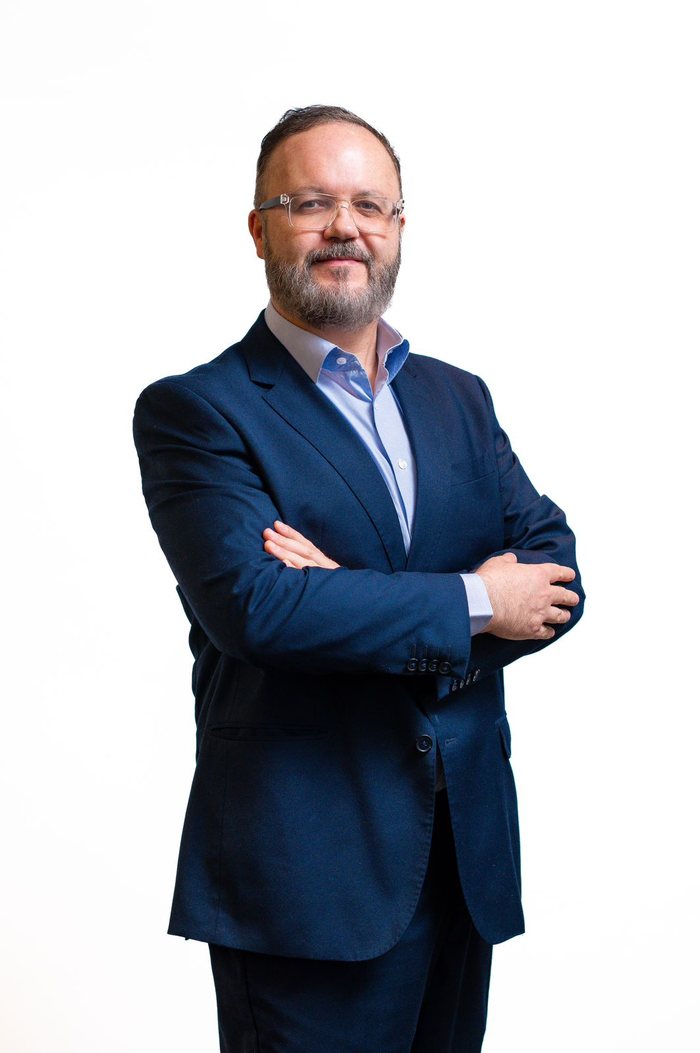
Ricardo de Abreu Barbosa holds a law degree and a doctorate in business administration from Universidade Presbiteriana Mackenzie in São Paulo, where he teaches and does research. He carried out his research on Actor-Network Theory at the University of Strathclyde in Glasgow, Scotland, and used it to study how regulation works in practice, where laws, institutions, researchers and documents meet, which is exactly the ground an innovation project has to stand on.
He teaches entrepreneurial project courses and, before his academic career, founded, ran and later sold a metalworking company. He therefore knows the side of the business that has to amend its articles, adjust its accounts and meet requirements before it can be hired. Finally, he has also lived and studied in Italy and Canada.
Contact
A few lines on who is involved in the project and where the conversation stopped are enough to get started.